
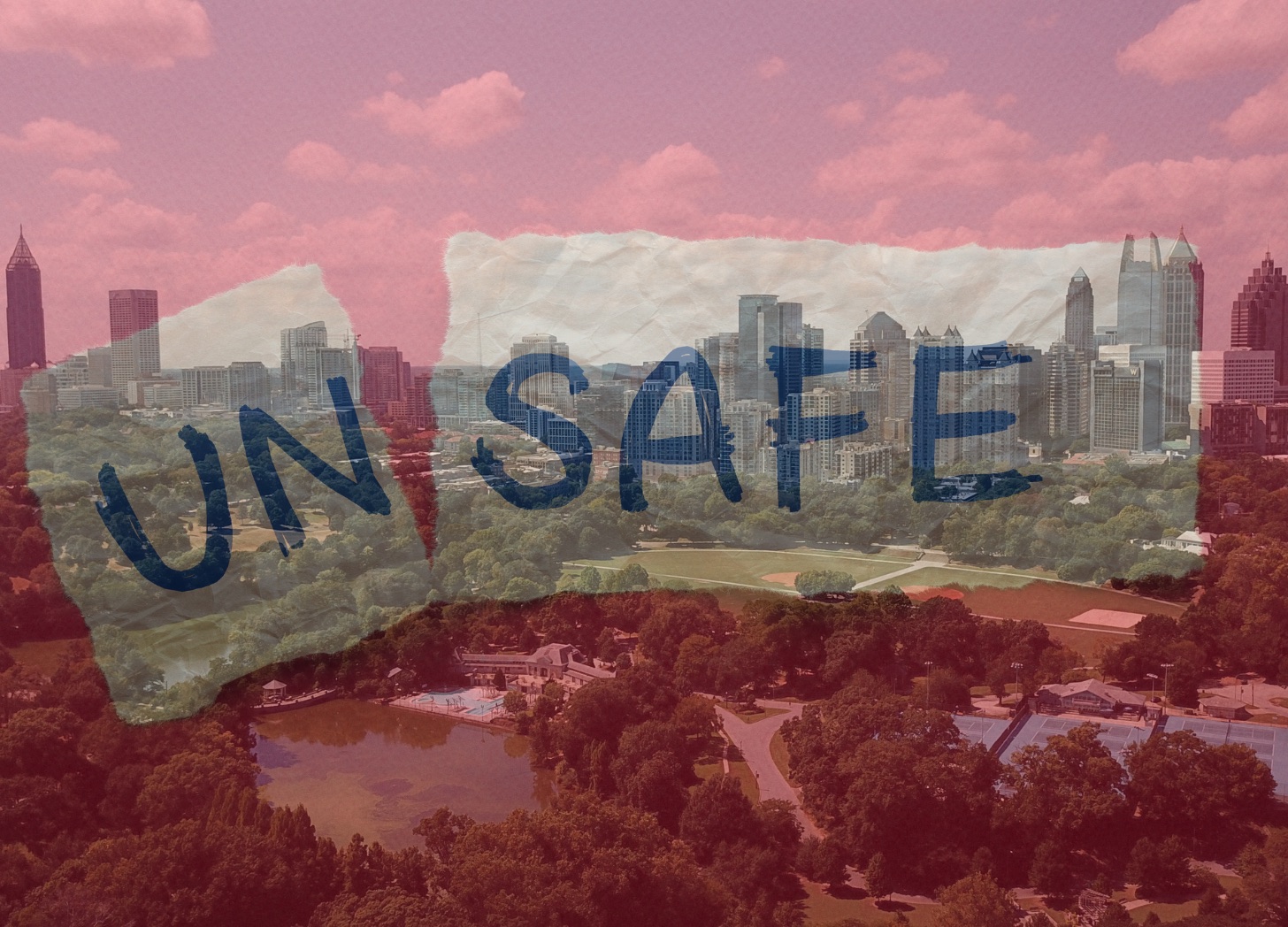
Let’s talk plainly. In the last two years, antisemitic violence and incitement in metro Atlanta have surged. These are not distant headlines. They show up on our campuses, on our streets, and in our inboxes. Leadership often looks unready for the moment. I say this as a proud Jew and an unapologetic Zionist who expects institutions to protect people, not reputations.
Right after Hamas’s October 7, 2023 massacre, Brookhaven residents woke to antisemitic flyers tossed on driveways under cover of night. Police picked them up. City workers denounced the cowardice. Then we hit the wall of law: distributing filth is “protected” speech. No legal recourse. One department floated littering charges. Littering. As if the problem were paper on lawns rather than hatred in public space.
Campus life felt it too. At Georgia Tech, students found “Free Palestine” in shaving cream across a Jewish fraternity wall beneath an Israeli flag. The message was explicit. Support Israel, pay a price. Campus police opened an investigation. I have not seen arrests. At Emory, a “pro-Palestinian” crowd disrupted a talk by Israeli reservists. Protesters reached through a fence at the Chabad House, grabbed an Israeli flag, and reportedly punched a Jewish student. Police arrested two adults for disorderly conduct. The university issued statements about viewpoints. Some protesters later filed a civil rights complaint claiming they were the aggrieved party because people filmed them. Moral inversion on full display.
Hate also marches in daylight. In Cobb, neo-Nazis paraded outside a synagogue with swastika flags and slurs. Families walked into Shabbat through a gauntlet of jeers. The Governor responded sharply. “There is absolutely no place for this hate… in our state,” said Brian Kemp. Condemnation matters. Yet the law allows public flag-waving unless a direct threat is made. The Goyim Defense League knows the rules and uses them. They dumped antisemitic flyers across Alpharetta, Roswell, Dunwoody, Sandy Springs, Kirkwood, and Marietta. Their Georgia representative even threatened to sue police for “interfering.” Poison flows under the banner of rights.
Sometimes the line is crossed. A bomb threat last forced the evacuation of the Jewish Federation building and the Holocaust museum in Midtown. SWAT cleared seventy people. Highways shut. It was a hoax, which is another way of saying the terror worked without a bomb. No perpetrator was found. A few months later a swastika was carved into a bench on Cheshire Bridge Road. Again, no one to hold accountable. Just another reminder that some neighbors want Jews to feel unsafe in their own city.
Now the part that stings. When we do identify a harasser, the system can still shrug. Fulton County recently prosecuted a “Pro-Palestinian” activist for assaulting a Jew. The prosecutors and defense attorneys were chummy and shared hugs. After days, they managed to secure an acquittal for the defendant. I was there as a witness to the attack. I saw a process that drags and where the DA’s office clearly didn’t care about the victim. The victim and I both walked out unprotected. That outcome sends a lesson to the next bully with a camera and a Telegram channel: you can get away with it. Too many do.
This is not a stack of isolated anecdotes. It is a pattern that matches national data. In the two weeks after October 7, antisemitic incidents in the United States jumped by nearly 400 percent compared to the prior year. Hundreds of cases were logged in that short span. At least 190 tied directly to rage over the war. When Israel fights for its citizens, antisemites here feel licensed. Atlanta is not exempt.
So no, “it can’t happen here” has expired. It is happening here. You see it in the tense posture at synagogue doors. You hear it in students who stop wearing a Magen David. You read it in the emails and voicemails sent to Jewish leaders. The Torah forbids standing idly by the blood of your neighbor. Lo ta’amod al dam re’echa. We do not stand idle.
What do we do? We insist on measurable protection rather than soothing statements. We demand police follow-through and prosecutorial backbone. We expect universities to name violence when it occurs and to defend Jewish life on their campuses without euphemism. We organize, train, and harden targets where necessary. We keep our humor, because Jews do that, but we keep our guard as well. And we tell our own story with clarity, not apology.
Funding Without Protection
We live in an age when antisemitism has returned to open daylight, yet money for protection is plentiful—at least on paper. The federal Nonprofit Security Grant Program, or NSGP, sends millions of dollars each year to “high-risk” organizations so they can harden their buildings, hire guards, and train their staff. In 2024, Georgia’s nonprofits received more than $11.6 million from that fund—nearly triple the amount from the year before. Each grant can reach $150,000 and covers cameras, reinforced doors, alarms, even fencing. In theory, this should make Jewish life in Georgia far safer than before.
Who actually gets the money and what does it do? The list is confidential, but common sense tells us it goes to the large institutions: the Federation campus, the major synagogues, the Jewish day schools, and the Marcus JCC. These are important centers of Jewish life, and they do need protection. By late 2024, Atlanta’s Federation reported that roughly $2.8 million in security grants had gone to local Jewish organizations—some government, some private. That is a serious investment.
So why do so many Jews still feel unsafe? Because having money is not the same as having security. Each institution fortifies its own walls, and there is no requirement to share. The synagogue that installs a $150,000 security system is under no obligation to help the smaller shul two miles away. The JCC’s cameras do not protect the Hebrew school that meets in a rented space. The structure rewards isolation: every nonprofit for itself. I’m glad the big institutions are harder targets now, but let’s be honest—a few fortified buildings do not equal a protected community.
The Secure Community Network, or SCN, operates under the umbrella of the Jewish Federations of North America. Atlanta’s Federation brought in its own SCN security director, a former FBI agent, to coordinate safety efforts. He offers webinars, liaises with law enforcement, and assures us that “preparedness and awareness” will keep us safe. It sounds professional and, I’m sure, sincere. Yet antisemitic flyers still land on our lawns. Vandals still carve swastikas. A Jewish student at Emory still got punched. None of that feels like “secure community” in action.
Most Jews outside the big institutional network remain on their own. The Atlanta Israel Coalition, for example, has no campus, no staff, and no grant money. It’s a volunteer effort focused on advocacy and education. When AIC members show up to counter a “pro-Palestinian” rally downtown, there is no taxpayer-funded guard standing beside them. Their protection, if it exists at all, comes from the police—though they often say to go away or hide one’s Jewishness.
This siloed system breeds complacency at the top and frustration at the grassroots. Smaller congregations ask how to apply for funding and whom to call for help. Independent Jews—those who simply live here and want to feel safe walking to synagogue—wonder if anyone includes them in “community security.” They are right to wonder. The Federation cannot guard every Jew in Atlanta, but it can do far more to empower them. The tools exist. The will is less evident.
Even as everyone sees antisemitism surging, local leadership held webinars and wrote statements. But we did not see the kind of rapid, visible coordination that cities like New York or Los Angeles managed—public meetings with officials, emergency task forces, explicit plans. Atlanta passed an antisemitism-definition bill in the legislature, which helps prosecutors down the road, but on the immediate security front we heard mostly silence.
We have the resources to make Jewish Atlanta a model of preparedness. What we lack is follow-through and shared responsibility. Grants buy cameras; they do not buy courage. As I put it after my ordeal in Fulton County, “Our leaders get the money, but we still get the threats.” The Talmud says kol Yisrael arevim zeh bazeh—all Israel is responsible for one another. Hardening one door while leaving another open does not fulfill that commandment. Until the institutions of Atlanta learn to extend protection beyond their own walls, the millions we celebrate in grant reports will remain numbers, not safety.
When Leadership Hesitates
Let’s talk about leadership—the kind that either steadies a community or leaves it exposed. Money, as we’ve discussed, matters. But what often matters more is how leaders use their time, voice, and moral capital when the pressure mounts. Across the United States, we’ve seen examples of Jewish leaders who acted decisively. They rallied, organized, demanded protection, and refused to let their communities feel alone. Others, by contrast, have struggled to find that same urgency. The difference is glaring.
Take Boston. Within days of the Hamas pogrom, the Combined Jewish Philanthropies—their Federation—mobilized. They opened lines with law enforcement, distributed emergency funds for synagogue security, and held a massive public rally on Boston Common. Thousands attended. The Governor and Mayor both spoke. The message was unmistakable: Jews will not be intimidated, and the state will stand with them. Governor Maura Healey even convened an interfaith safety council and activated the National Guard to assist near houses of worship. That’s how partnership looks when civic leaders and Jewish leaders act in sync.
Now look at Los Angeles. By late October, the Jewish Federation there created an Emergency Security Grant program to put guards at Jewish schools and synagogues immediately—no waiting for bureaucratic grants. They raised half a million dollars overnight and placed guards at thirty-one synagogues, twelve schools, and several camps. Within a year, they distributed nearly two million dollars in security aid to over a hundred Jewish institutions. They acted with clarity: protect the children first, secure the community next. That is leadership.
Atlanta, meanwhile, held a staff retreat. Yes, an actual retreat—Camp Ramah Darom, May 2024. There was team-building, a DJ, and improv comedy. I understand the need for morale, but the optics were unfortunate. While the community faced record antisemitism, Federation staff were off in the mountains giving each other awards for enthusiasm. Eric Robbins, the outgoing CEO, celebrated his final retreat as president. Mazel tov. But perhaps the victory lap was premature. I would rather see a celebration for securing every synagogue and school in the region.
Consider New York City. Within a week of October 7, Governor Kathy Hochul and Mayor Eric Adams launched an Interfaith Security Council. The NYPD increased patrols around Jewish neighborhoods. The UJA-Federation funded additional guards for dozens of yeshivot and synagogues. Leaders were in daily contact with law enforcement and spoke publicly about antisemitic violence. Compare that to Atlanta, where our Federation and JCRC issued the usual statements about tolerance. I have yet to see them challenge Emory University’s administration for its weak handling of campus antisemitism. When Jewish students were harassed, silence followed—except from the grassroots faculty and students who wrote their own open letter. They filled the vacuum that leadership left.
Even in symbolic terms, other cities showed more speed. Chicago’s Jewish United Fund organized a rally for Israel almost immediately. Atlanta’s largest gathering was on October 10 in Sandy Springs—well attended, about five thousand people—but it was organized largely by Israeli expats and volunteers. Federation joined later. The community led; the institutions followed. That has become our pattern.
There was also the attack on Norman and Lindy Radow, a philanthropic couple who hosted a small pro-Israel event downtown last November. Their car was surrounded by a mob shouting “Allahu akbar.” They feared for their lives. The story made the Atlanta Jewish Times and a few local outlets, then vanished. No arrests. No press conference demanding accountability. No visible show of solidarity from the Federation. If the same had happened in Los Angeles, there would have been cameras, statements, and action within hours. Here—nothing.
This pattern should disturb us. We Jews are small in numbers. Our survival has always depended on unity and courage. When danger approaches, leaders are supposed to lead—not by memo, but by presence. The Torah expects that of them. Our tradition praises shepherds who stand between the flock and the wolves. History records what happens when they do not. Too many rabbis in 1930s Europe urged calm as hostility grew. They hoped diplomacy and good citizenship would shield them. Ze’ev Jabotinsky saw what they did not. He spent the 1930s pleading with Eastern European Jews to leave while they still could. “You are living on the edge of a volcano,” he warned. Many dismissed him as alarmist. He was right. His example remains a warning: polite leadership cannot save a people under siege.
No one here is suggesting that America is Nazi Europe. Thank G-d, we live in a nation built on laws and decency. But Jewish history teaches us to recognize early warning signs and to act before the fire spreads. In some cities, Jewish leaders grasp this. They build alliances, demand protection, and confront antisemitism openly. In others, too often, we see hesitation. The moral reflex has dulled. Leaders worry about offending donors or jeopardizing relationships with universities. The result is paralysis disguised as professionalism.
This must change. Leadership need to engage publicly and persistently. Meet every police chief. Push for visible patrols and prosecutions. Train volunteers if manpower is short. Speak without euphemism when Jewish students or families are threatened. Make it clear that the Jewish community is organized, vocal, and unafraid. If our current leadership finds that uncomfortable, they should step aside for those who are ready.
Hillel said, b’makom she’ein anashim, hishtadel lihyot ish—in a place where there are no men, strive to be a man. In today’s language, that means if leadership is missing, take its place. Many ordinary Jews already are. They organize rallies, watch each other’s backs, and refuse to stay silent. They embody what leadership should look like. It is time for our institutions to catch up. Atlanta’s Jewish story is rich with resilience. Let’s make sure our leaders remember that legacy and act with the urgency it demands.
Viral Hate, Real Damage
Let me start with something concrete. A video landed in a community inbox. A woman, who perjured herself at that Fulton County trial I mentioned earlier, presented herself as a “Palestinian” speaking for “all the Palestinians,” looks into the camera and lays out her “solution.” “We just need to demolish, abolish, destroy Israel and all the Zionists off the face of the earth.” She thanks a foreign head of state for echoing her view. Then she calls Israel a cancer to be cut out. That is not policy debate. That is a call for genocide.
Under American law we draw a hard line between vile speech and prosecutable incitement. The Supreme Court’s Brandenburg standard requires intent and likelihood to produce imminent lawless action. The video urges a global campaign, not a specific and immediate attack. On that narrow ground, it may fall on the protected side of the line. Legally protected does not mean harmless. When such messages arrive in your inbox, they are meant to intimidate. They succeed at that.
We have seen how online poison spills into the street. After October 7, the FBI and DHS warned about a surge in violent messaging that praised Hamas and threatened Jews. The numbers tracked with the warnings. In roughly the first two and a half weeks after the war began, the ADL recorded 312 antisemitic incidents in the United States, a jump of about 388 percent over the prior year’s pace. Many tied directly to war-related narratives. Rallies branded as “Pro-Palestinian” featured chants that glorified terror and normalized violence. Words like “From the river to the sea” do not describe a two-state map. They erase the only Jewish state. I wonder (not really, I know) what they mean to do with the Jews?
Consider two cases that stayed mostly online-only since law enforcement intervened. At Cornell, a student posted threats to shoot Jews at the kosher dining hall and to rape Jewish women. He was arrested before he could act, but the fear he created was real and lingering. In New York, authorities detained a man who spread propaganda about killing Jews and appeared to be preparing for it. This is the pattern: digital escalation, then a shattered window or worse.
Atlanta sits in this same information stream. The flood reaches us. Since October 2023, community accounts have received a steady stream of messages that label Jews as monsters and promise personal attention to named individuals. Much of it is performative bravado. Enough of it is not. Volunteers report a change in tone at counter-rallies: louder threats, less hesitation, more people eager to film Jews and post their faces with abuse. You can feel the temperature rise.
We are used to being told to “imagine a world without Israel.” We can also imagine a world where platforms enforce their own rules against calls for genocide. TikTok and Telegram do not need a Supreme Court case to remove a video that says “destroy all Zionists.” They need a spine.
The ethical frame here is not complicated. Judaism prizes life, dignity, and restraint. Pikuach nefesh—the saving of life—overrides almost every other commandment. Lo ta’amod al dam re’echa—do not stand idly by your neighbor’s blood—requires action when harm looms. When online mobs normalize violence against Jews, we act. We report. We document. We insist that police treat “kill the Jews” posts with the urgency they would give a school shooting threat. We ask prosecutors to use the tools they already have for true threats and stalking. We expect campus administrations to name antisemitism without euphemism and to protect Jewish students as they would any targeted minority.
To the woman in the video and those who cheer her on, a simple response. Jews are not leaving history. Israel is not vanishing. Threaten us and you will meet law, community, and a people with a long memory. To our neighbors who may not follow every detail of the Middle East: this is not a zoning dispute in Judea and Samaria. This is open advocacy of extermination aimed at your Jewish colleagues and friends. That should offend every liberal instinct you hold dear.
Never Again Means Now
Many of us feel exhausted by the drumbeat of threats—local, global, physical, digital. I do too. Yet this is exactly the kind of moment our own moral tradition prepares us for. Jewish history doesn’t teach complacency; it teaches responsibility. The Hebrew term is arevut—mutual responsibility. It means that the fate of one Jew belongs to all Jews. Kol Yisrael arevim zeh bazeh—“All Israel is responsible for one another.” Our sages did not intend that as decorative calligraphy for a synagogue wall. They meant it as a directive for moments like this.
If you have influence, use it. If you have means, share them. If your title carries authority, it also carries obligation. No Jew stands alone. Either we stand up for each other now, or we will face the consequences alone later. Watching harm unfold and shrugging is not neutrality. Today Jewish blood is again at risk. Maybe not in mass graves, but in the beatings, harassment, and fear spreading through our communities. Do not stand idly by.
History offers enough warnings. Moral audacity can work. Sometimes the “outsiders” understand urgency better than those guarding their reputations. For example, in New York in the 1970s, Jews patrolled the streets to protect Soviet immigrants from Nazi gangs. Some in the establishment worried about optics—armed Jews in Brooklyn!—but those patrols stopped the attacks. And when Boston synagogues were vandalized in the 1990s, Jewish groups didn’t just issue press releases; they partnered with police and stood in those cemeteries until the culprits were caught. Leadership looks like that: presence, not prose.
Natan Sharansky, the Soviet refusenik, said Jewish history can be reduced to three words: “Don’t trust silence.” He was right. Silence is the permission slip every antisemite hopes for. When school principals stay quiet after Jewish kids are bullied, when prosecutors drag their feet on hate crimes, that silence echoes the passivity that enabled past disasters. The task before us is to break that silence—loudly, persistently, and without apology.
If our leaders see this as public relations rather than avodah kodesh—holy work—they’ve missed the point. The rabbinic question, “If not now, when?” was not rhetorical. If not after open calls for Jewish blood, then when exactly do we act?
Defending ourselves is not shameful. We are defending the civilization that protects conscience and difference—the very values antisemites seek to destroy. Whether they come draped in swastikas, keffiyehs, or academic jargon, the enemies of the Jewish people are enemies of liberal democracy itself. When we stand for Israel, when we fight antisemitism, we stand for freedom, pluralism, and truth. That alignment is not coincidence; it is moral logic.
Some will say this tone is alarmist. Fine. History shows that underreacting has cost more Jewish lives than overreacting ever did. Edmund Burke warned that evil triumphs when good men do nothing. We will not apologize for defending ourselves. We will not lower our voices to make bigots comfortable.
So, to Atlanta’s Jewish leadership: the alarm is sounding. You have the data, the funds, and the moral tradition. Use them. Lead as if Jewish lives depend on it, because they do. Lead as if the future of our people depends on it, because it does. To the rest of us: if the official leaders will not lead, then we will. Kol Yisrael arevim zeh bazeh is not conditional. We have each other, and that is enough to begin.
We inherit the stubborn courage of Joshua, of the Maccabees, of the partisans in the forests, of the IDF soldiers standing guard today. Their message to us would be simple: Never Again is not a slogan. It is a command, and it means now. In Atlanta, in 2025, we act. We build alliances, strengthen defenses, and name evil without flinching. We protect our children and our dignity. And we do it together, as Jews who remember, as Americans who value freedom, and as inheritors of a faith that refuses to yield. Jewish history is watching. Let’s make it proud.