Learn With AIC
Israel Explained
Plain answers to the questions people ask most about Israel, Zionism, and the conflict. Every fact links to a source you can open and check.
Israel at a Glance
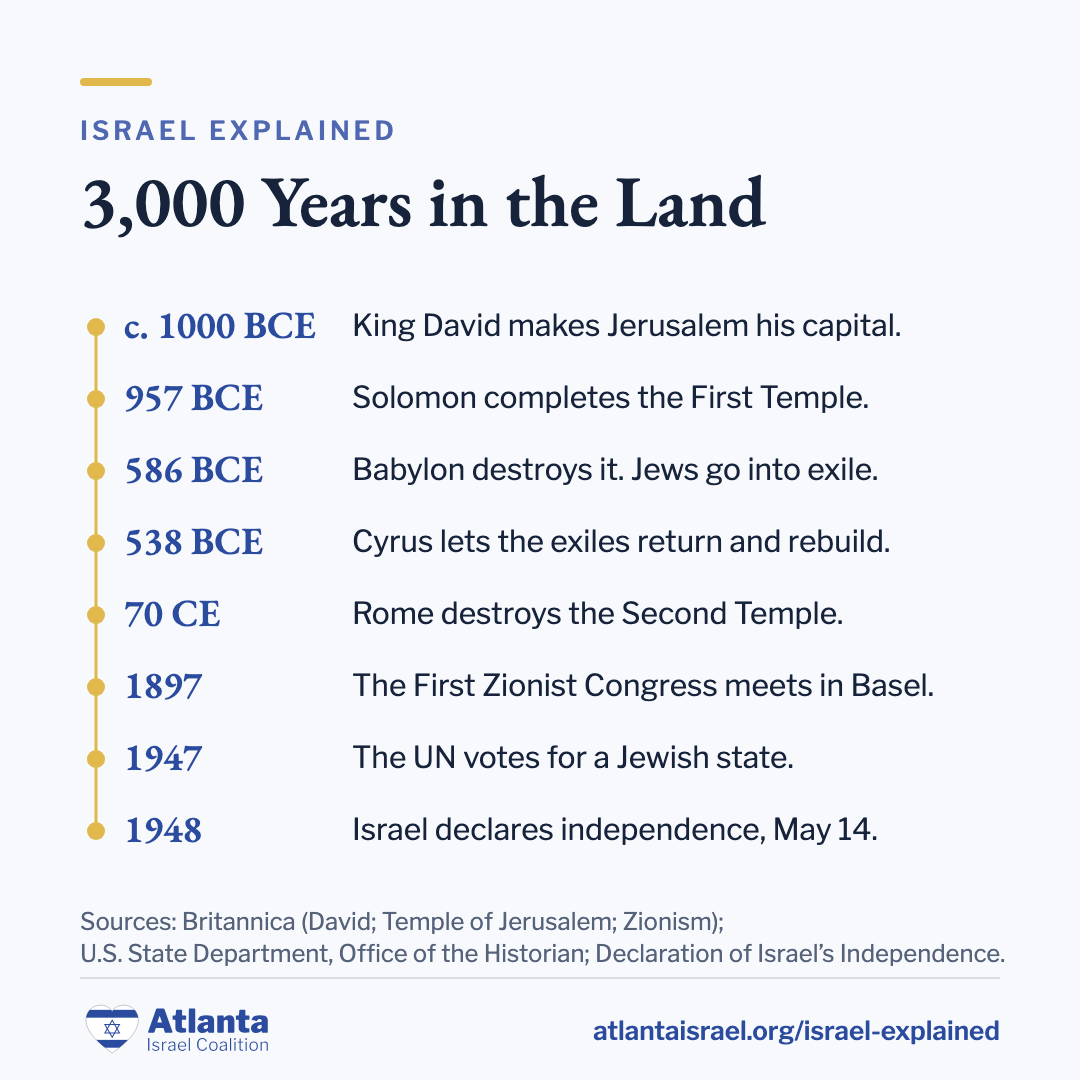
- Israel is the Jewish people’s homeland. About 3,000 years ago, King David made Jerusalem the capital of the kingdom of Israel.
- The modern State of Israel declared independence on May 14, 1948. It’s a democracy of about 10.2 million people, and about one in five is an Arab citizen.
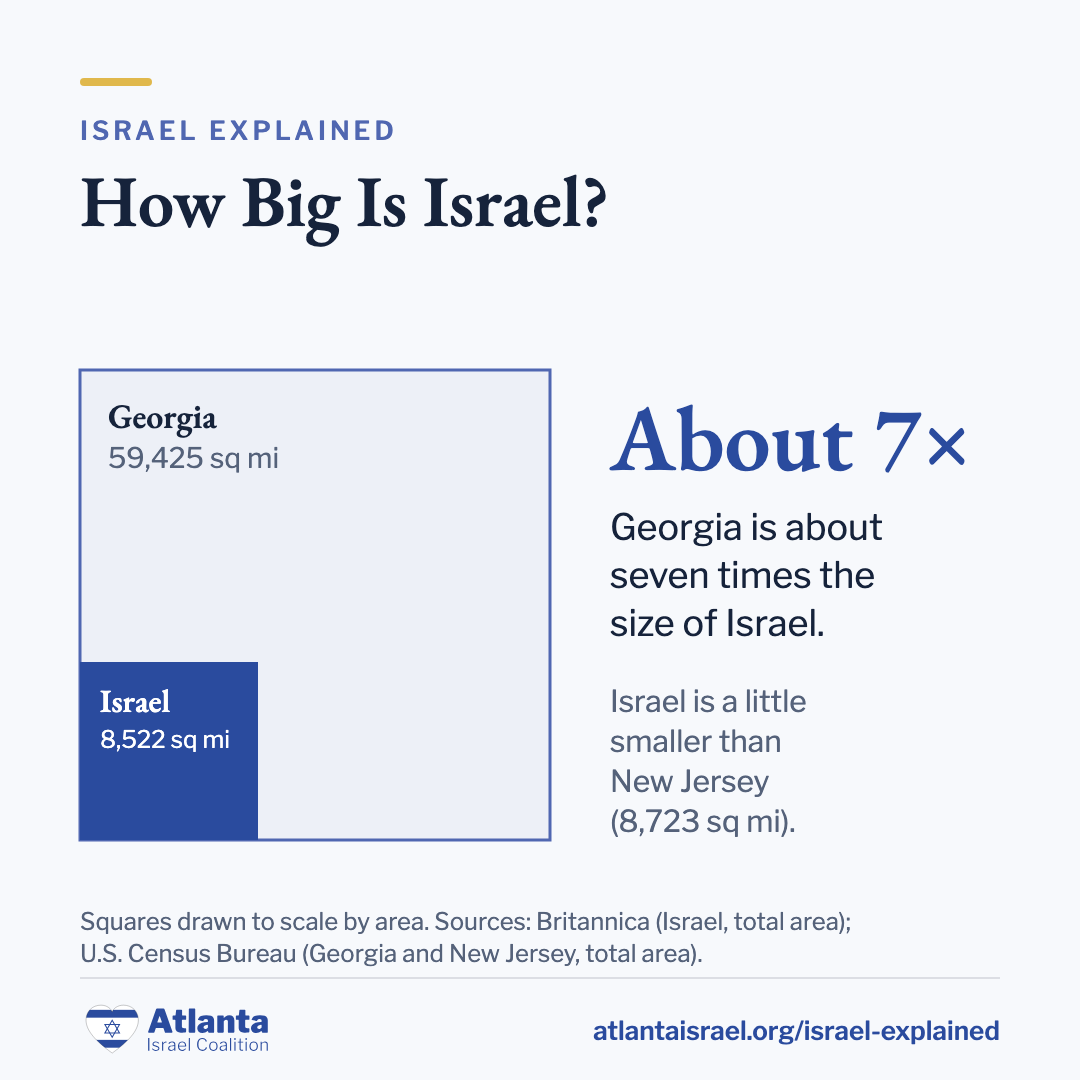
- It’s small. Georgia is about seven times bigger.
- Zionism is the Jewish people’s bond with that land and the hope of going back to it. It’s as old as the exile. In 1897 it became a political movement.
- In 1947 the UN voted for a Jewish state and an Arab state side by side. The Arab leadership refused, and five Arab armies invaded the day Israel was born.
- Israel has signed peace with Egypt, Jordan, and four more Arab countries since 2020.
What Is Israel?
Israel is the homeland of the Jewish people, and today it’s the Jewish state and a democracy. Every citizen 18 and older votes for the Knesset, Israel’s 120-member parliament.
About 10.2 million people live in Israel. Roughly three in four are Jews and others, and about one in five are Arab citizens. Israel’s founding declaration promised every one of them “complete equality of social and political rights … irrespective of religion, race or sex.” In 2021 a party representing Arab citizens joined the governing coalition.
It’s a small country: about 8,500 square miles, a little smaller than New Jersey. You could fit Israel into Georgia about seven times.
Sources: Israel Central Bureau of Statistics, Independence Day 2026; Britannica, Knesset; Declaration of Israel’s Independence, 1948 (Avalon Project, Yale Law School); Britannica, Naftali Bennett; Britannica, Israel facts; U.S. Census Bureau, state area measurements.
Where Did Israel Begin?
Israel’s story starts thousands of years before 1948. In the Bible, God promises the land to Abraham: “all the land which thou seest, to thee will I give it, and to thy seed for ever.”
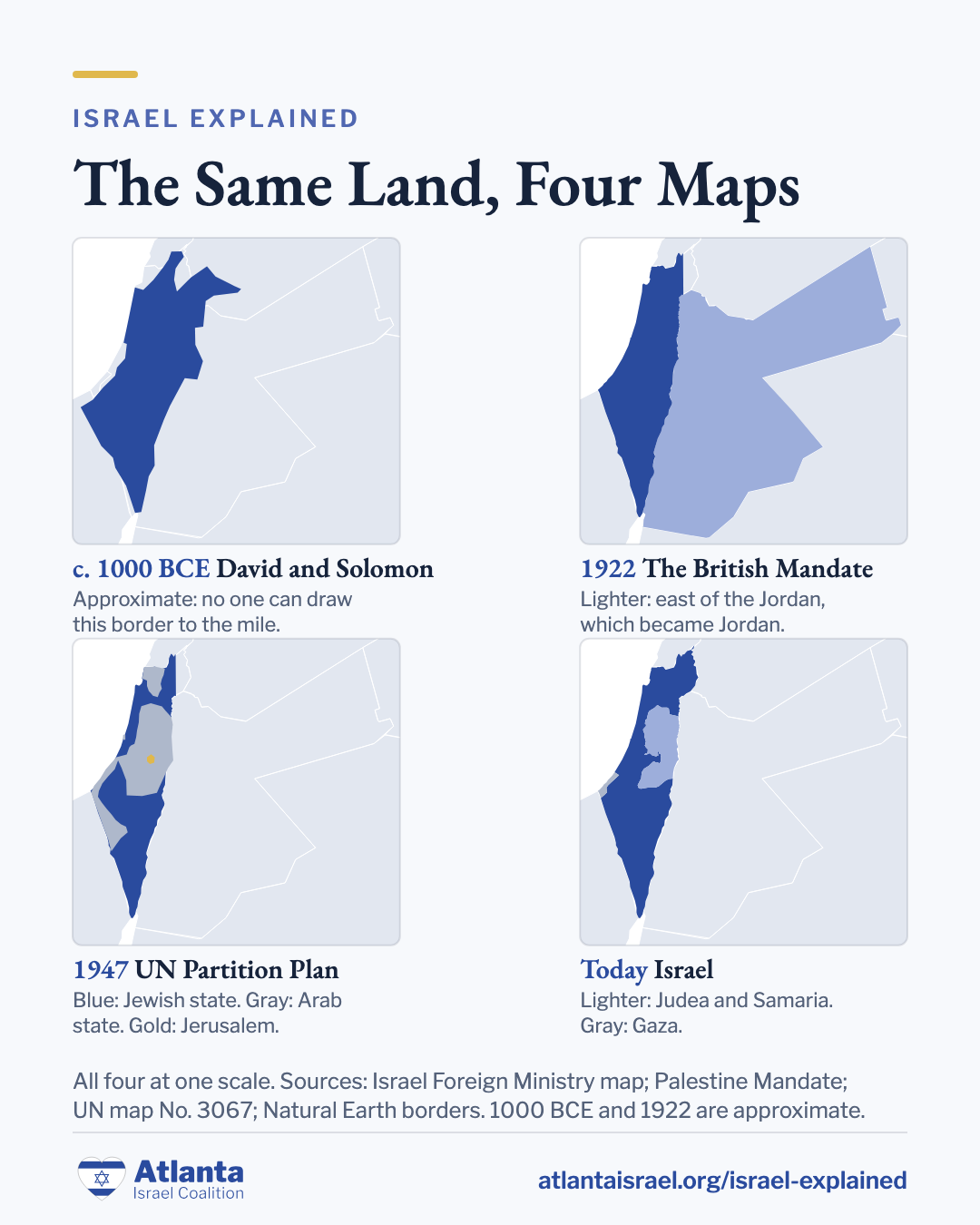
About 3,000 years ago, King David took Jerusalem and made it the capital of a united kingdom of Israel and Judah. His son Solomon built the First Temple there and finished it in 957 BCE.
In 586 BCE the Babylonians destroyed the Temple and carried Jews away into exile. In 538 BCE the Persian king Cyrus let them go home and rebuild, and the Second Temple was finished in 515 BCE.
In 70 CE the Romans destroyed the Second Temple. Part of the wall around it, the Western Wall, still stands, and it’s still the focus of Jewish hopes and pilgrimage. In the next century the Romans started calling the land Syria Palaestina, a name that goes back to the Philistines. That’s where the name Palestine comes from.
So 1948 wasn’t the start of Israel. It was the Jewish people getting their state back.
Sources: Genesis 13:15 (JPS 1917 translation, Sefaria); Britannica, David; Britannica, Temple of Jerusalem; Britannica, Palestine; Declaration of Israel’s Independence, 1948 (Avalon Project, Yale Law School).
What Is Zionism?
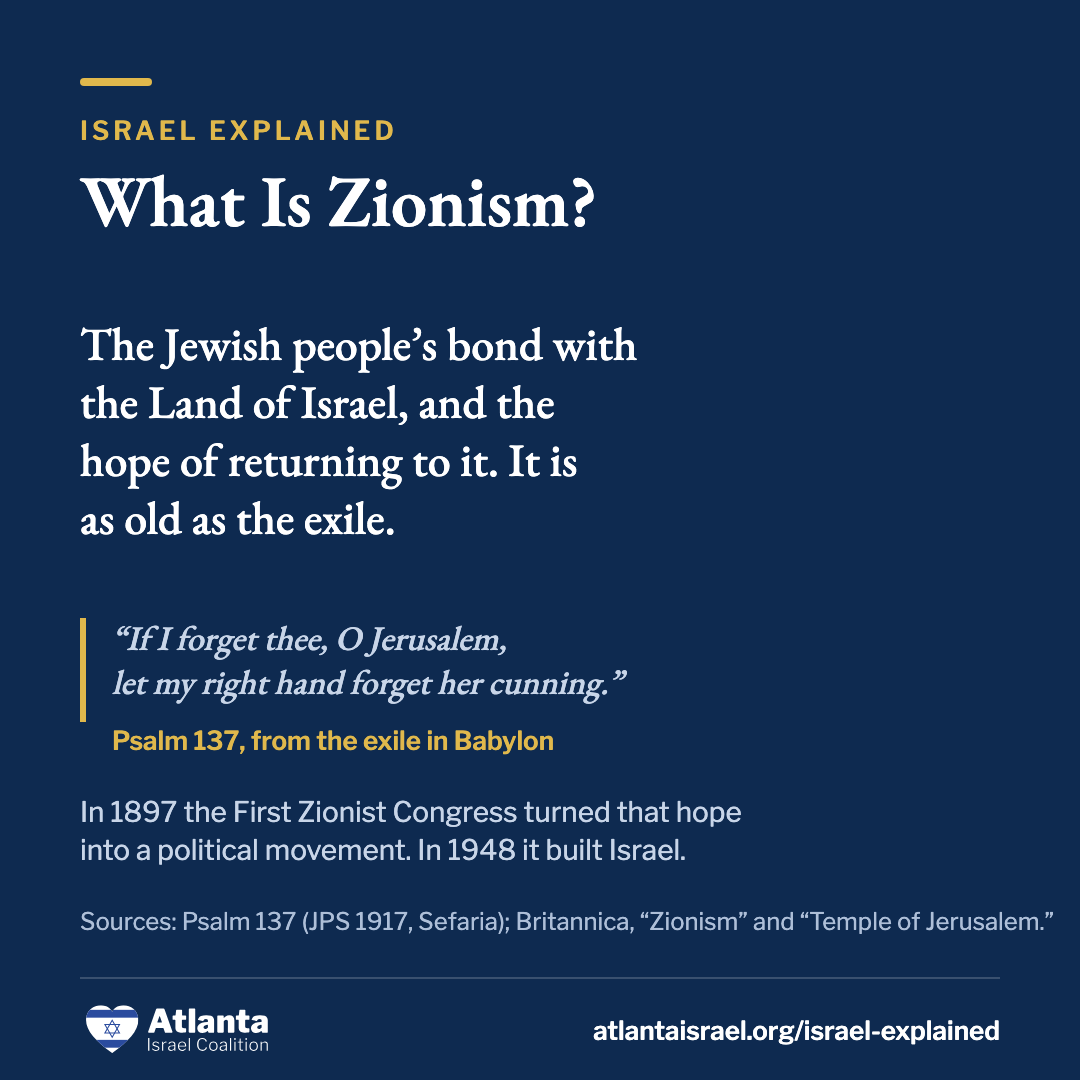
Zionism is the Jewish people’s bond with the Land of Israel and the hope of going back to it. The name comes from Zion, one of the hills of ancient Jerusalem. The idea is as old as the exile itself.
The exiles in Babylon sang it: “By the rivers of Babylon, there we sat down, yea, we wept, when we remembered Zion,” and “If I forget thee, O Jerusalem, let my right hand forget her cunning.” Jews have said it ever since. Every Passover Seder still ends with “Next year in Jerusalem.” Israel’s Declaration of Independence puts it this way: Jews “never ceased to pray and hope for their return,” and “in every successive generation” they worked to get back.
In the 1800s that hope became a political movement. In Eastern Europe, groups called the Lovers of Zion started settling Jewish farmers in the land. Theodor Herzl, an Austrian journalist, decided antisemitism would never let Jews simply blend in, and in 1897 he brought together the first Zionist Congress in Basel, Switzerland. Its program said Zionism “strives to create for the Jewish people a home in Palestine secured by public law.” Britannica puts it simply: modern Zionism is “a continuation of the ancient attachment of the Jews and of the Jewish religion” to the land.
Today a Zionist is someone who supports the Jewish people’s right to their state. You don’t have to be Jewish to be one, and many of AIC’s partners aren’t.
Sources: Psalm 137 (JPS 1917 translation, Sefaria); Passover Haggadah, “Next Year in Jerusalem” (Sefaria); Declaration of Israel’s Independence, 1948 (Avalon Project, Yale Law School); Britannica, Zionism; Britannica, Temple of Jerusalem.
How Was Modern Israel Born?
The world recognized the Jewish people’s claim before Israel was a state. In 1917 Britain backed “the establishment in Palestine of a national home for the Jewish people.” In 1922 the League of Nations, the body that came before the UN, wrote “the historical connection of the Jewish people with Palestine” into the Mandate that put Britain in charge of the land.
On November 29, 1947, the UN General Assembly voted to divide the land into a Jewish state and an Arab state, with Jerusalem under international control. The Arab leadership refused to accept it, and fighting broke out right away.
On May 14, 1948, Israel declared independence. In the same declaration it said it was ready to carry out the UN’s plan, and it offered every neighboring country “peace and good neighborliness.” The answer came immediately: the armies of five Arab nations invaded.
Israel survived. By 1949 it had signed armistice lines with Egypt, Lebanon, Jordan, and Syria. Egypt held Gaza, and Jordan held Judea and Samaria, until 1967.
Sources: The Balfour Declaration, 1917 (Avalon Project); The Palestine Mandate, 1922 (Avalon Project); UN General Assembly Resolution 181, 1947 (Avalon Project); U.S. State Department, Office of the Historian: the 1948 war; Declaration of Israel’s Independence, 1948 (Avalon Project, Yale Law School).
What Is the Conflict About?
At its heart, the conflict is about whether a Jewish state should exist at all. You can see it in the record.
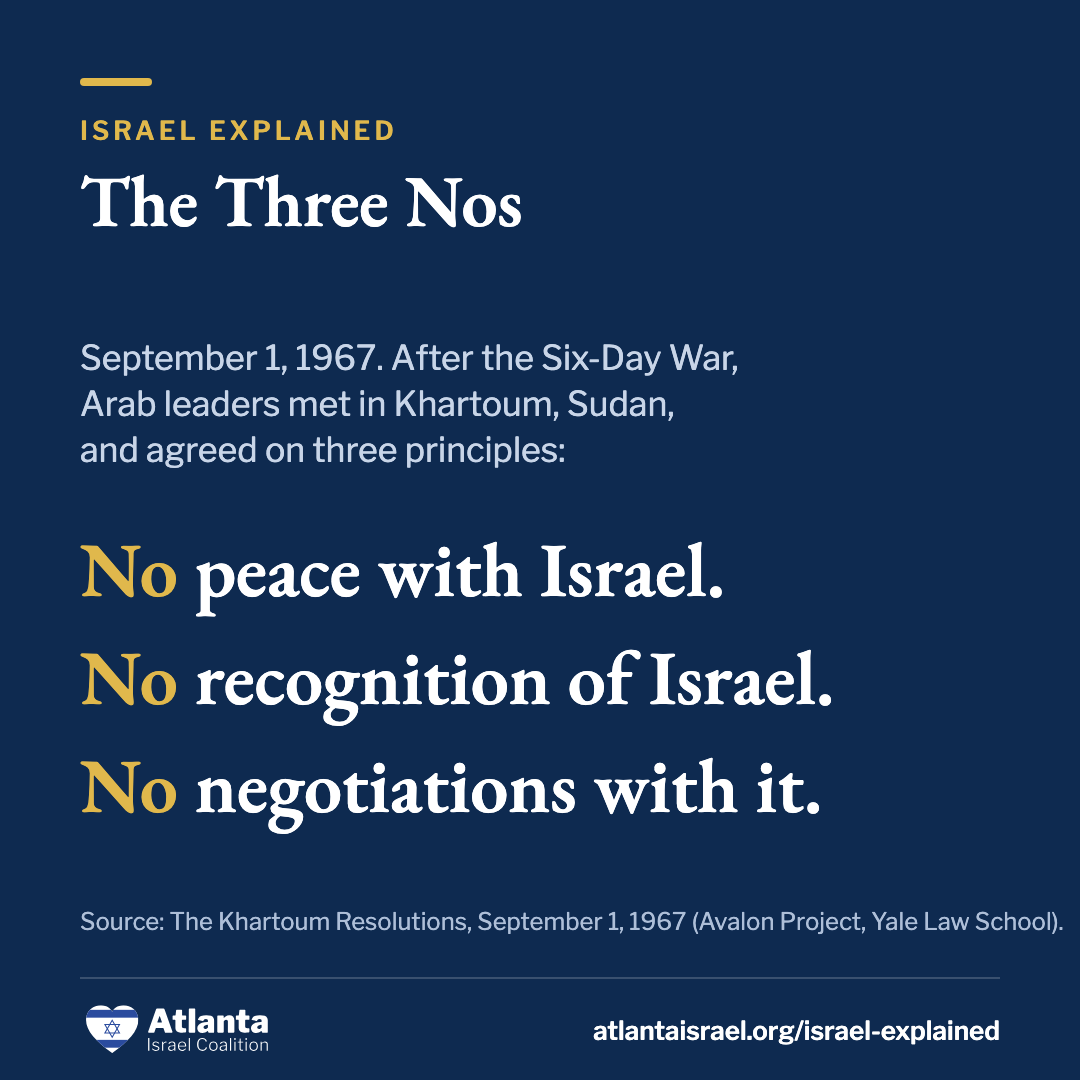
In 1947 the Arab leadership refused the UN plan. The goal of the fighting that followed, in the words of the U.S. State Department’s historians, was “to prevent the establishment of the Jewish state.” In May 1967 Egypt closed the Straits of Tiran to Israeli ships. In the six days of war that followed in June, Israel defeated Egypt, Jordan, and Syria, and took Gaza, the Sinai, Judea and Samaria, east Jerusalem, and the Golan Heights. That September, Arab leaders met in Khartoum and answered with three nos: “no peace with Israel, no recognition of Israel, no negotiations with it.”
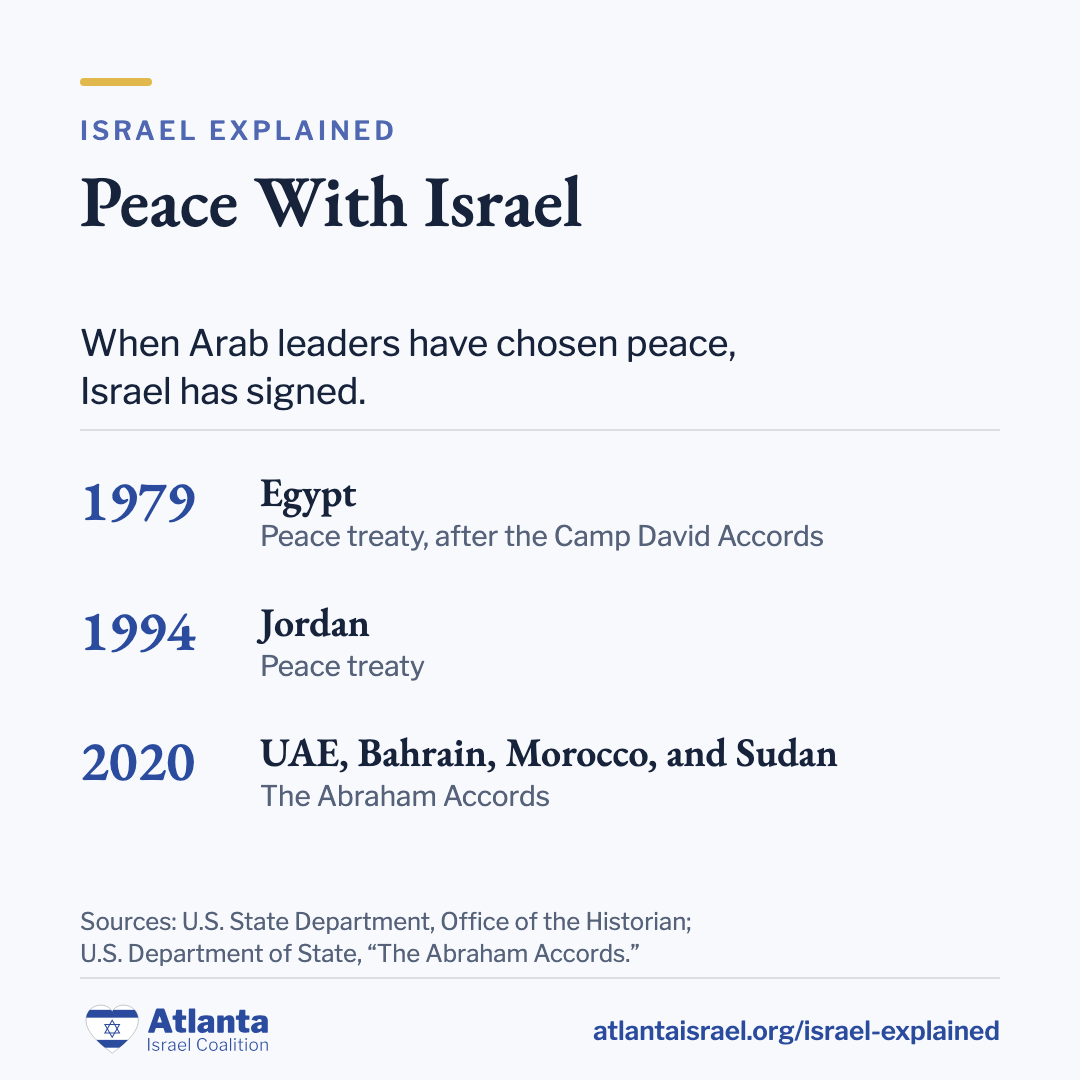
When Arab leaders have chosen peace, Israel has signed. Egypt and Israel made peace in 1979, and Jordan followed in 1994. In 1993 Israel and the PLO signed the Oslo Accords. In 2005 Israel pulled its soldiers and its civilians out of Gaza and handed control to the Palestinian Authority. Two years later Hamas seized control of Gaza. Its founding charter says “there is no solution for the Palestinian question except through Jihad.”
Since 2020, the United Arab Emirates, Bahrain, Morocco, and Sudan have signed the Abraham Accords with Israel.
Sources: U.S. State Department, Office of the Historian: the 1948 war; Office of the Historian: the 1967 war; The Khartoum Resolutions, 1967 (Avalon Project); Office of the Historian: Camp David and the Egypt-Israel treaty; Office of the Historian: the Oslo Accords; Britannica, Gaza Strip; Hamas Covenant, 1988 (Avalon Project); U.S. Department of State, the Abraham Accords.
Why Say Judea and Samaria?
Judea and Samaria are the names this land has carried for about 3,000 years. Judea takes its name from the tribe of Judah, and it’s where most of the Jewish people’s early history happened: Jerusalem, Bethlehem, and Hebron. Samaria, just to the north, was home to the northern kingdom of Israel from about 922 BCE until the Assyrians overran it in 722 BCE.
Under the 1922 Mandate, this land was part of the Jewish national home, where Britain was told to encourage “close settlement by Jews on the land.” The Mandate let Britain hold those terms back only east of the Jordan River.
“West Bank” is a much newer name. Jordan’s army held the area at the end of the 1948 war, and Jordan annexed it in 1950. It started calling it the West Bank to set it apart from the rest of Jordan, on the East Bank of the river. Only two countries, Britain and Pakistan, recognized that annexation.
The lines that drew its edges were never meant to be borders. Israel and Jordan wrote that into their 1949 armistice: the lines were agreed “without prejudice to future territorial settlements or boundary lines.”
Israel took the area from Jordan in the Six-Day War of 1967, and in December 1967 it began officially calling it Judea and Samaria again. Then Jordan let go. On July 31, 1988, King Hussein announced that Jordan was dismantling “the legal and administrative links between the two banks” and gave up its claim.
So when AIC says Judea and Samaria, we’re using the land’s names from Jewish history. “West Bank” comes from an annexation almost nobody recognized, and that Jordan itself gave up.
Sources: Britannica, “What Does the Term ‘Judea and Samaria’ Mean?”; The Palestine Mandate, 1922 (Avalon Project); Britannica, West Bank; Israel-Jordan General Armistice Agreement, 1949 (Avalon Project); King Hussein, address on disengagement, July 31, 1988 (kinghussein.gov.jo).
What Happened on October 7?
On October 7, 2023, Hamas terrorists broke through from Gaza into southern Israel. They killed about 1,200 people, most of them Israeli civilians, in their homes, in their kibbutzim, and at an outdoor music festival. They took more than 240 people back into Gaza as hostages.
Israel went to war with two goals: bring the hostages home, and take apart Hamas so it can’t do this again. The War Explained covers what happened next, and how Israel has fought.
Sources: Britannica, Israel-Hamas War.
What About the Jewish Refugees?
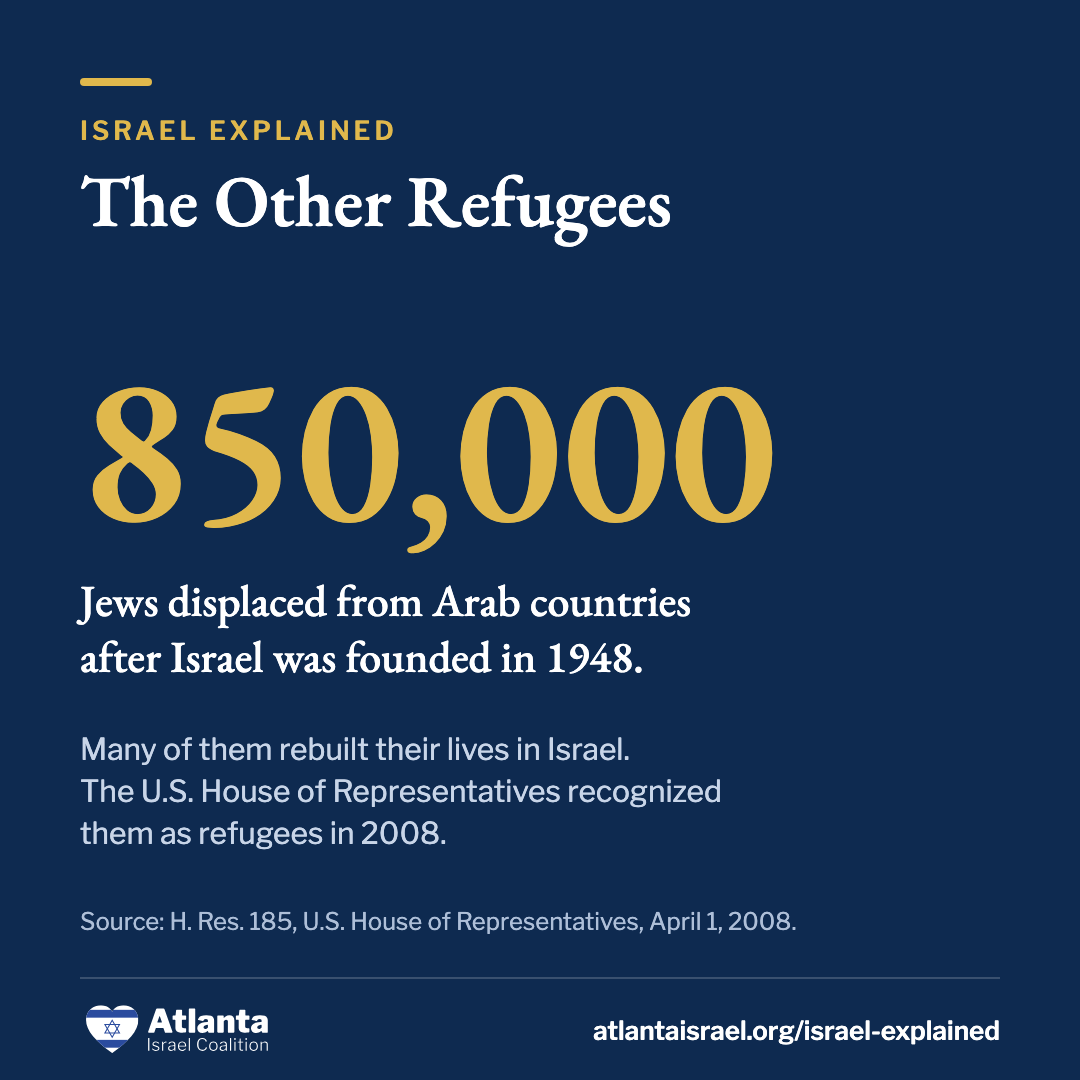
About 850,000 Jews were displaced from Arab countries after Israel was founded in 1948, and many of them rebuilt their lives in Israel. In 2008 the U.S. House of Representatives passed a resolution saying any Middle East peace agreement has to address the rights of these Jewish refugees, too.
Sources: U.S. House Resolution 185, 2008.
Is Antizionism Antisemitism?
Yes. You can criticize an Israeli government the way you’d criticize any government. Saying that the Jewish people, alone among the world’s peoples, have no right to a state of their own is something else.
The International Holocaust Remembrance Alliance drew that line in its working definition of antisemitism, adopted in 2016. It says “criticism of Israel similar to that leveled against any other country cannot be regarded as antisemitic.” And one of its examples of antisemitism is “denying the Jewish people their right to self-determination, e.g., by claiming that the existence of a State of Israel is a racist endeavor.”
Georgia uses that definition. HB 30, signed into law on January 31, 2024, has state agencies consider it when they decide whether an act was driven by antisemitism. AIC brought people to the State Capitol to ask legislators to pass it.
Sources: IHRA working definition of antisemitism; Georgia General Assembly, HB 30.
Common Questions
How old is Israel?
The modern State of Israel was founded on May 14, 1948. The Jewish people’s history in the land goes back much further: King David made Jerusalem his capital about 3,000 years ago, and Solomon finished the First Temple there in 957 BCE.
Sources: Declaration of Israel’s Independence, 1948 (Avalon Project, Yale Law School); Britannica, David; Britannica, Temple of Jerusalem.
Is Israel a democracy?
Yes. Every citizen 18 and older votes for the Knesset, Israel’s 120-member parliament, and Arab citizens vote in the same elections. In 2021 a party representing Arab citizens joined the governing coalition.
Sources: Britannica, Knesset; Britannica, Naftali Bennett.
What is the capital of Israel?
Jerusalem. It has been Israel’s capital since 1950, and it is home to Israel’s President, parliament, and Supreme Court. Since 1995, United States law has said Jerusalem should be recognized as Israel’s capital.
What are Judea and Samaria?
Judea and Samaria are the historic names of the hill country north and south of Jerusalem, where much of early Jewish history happened. Jordan annexed the area in 1950 and called it the West Bank; only Britain and Pakistan recognized that. Israel took it in 1967, and in 1988 Jordan gave up its claim. The 1995 Oslo II agreement divided it into areas under Israeli control, areas under Palestinian control, and areas where Israel handles security and the Palestinian Authority runs civil affairs.
Sources: Britannica, “What Does the Term ‘Judea and Samaria’ Mean?”; Britannica, West Bank; King Hussein, address on disengagement, July 31, 1988 (kinghussein.gov.jo); Office of the Historian: the Oslo Accords.
Can you criticize Israel without being antisemitic?
Yes. The IHRA working definition of antisemitism says criticism of Israel like the criticism leveled at any other country is not antisemitic. Denying the Jewish people the right to a state at all is.
Sources: IHRA working definition of antisemitism.
How many people live in Israel?
About 10.2 million, as of Israel’s Independence Day in April 2026. About 7.8 million are Jews and others, about 2.2 million are Arab citizens, and about 300,000 are foreign residents.
Sources: Israel Central Bureau of Statistics, Independence Day 2026.
Where can I learn more about Israel in Atlanta?
AIC hosts Israel Up Close, live talks twice a month, and the Mitzpe Institute, AIC’s educational program, sends the Israel Brief Sunday to Friday. Both are open to everyone.
Graphics to Share
Every graphic on this page is free to download and post. Each one names its source at the bottom, so anyone who sees it can check it.
Keep Learning With AIC
The Atlanta Israel Coalition is a nonpartisan nonprofit that teaches about Israel, the Jewish homeland, and fights antisemitism. Everyone is welcome. Twice a month, Israel Up Close brings you live talks on Israel, and the Mitzpe Institute’s Israel Brief lands in your inbox Sunday to Friday.
Give
Your gift funds the work.
Community briefings, advocacy training, humanitarian missions to Israel, and the Kosher Duck Revolution, with specifics on every tier.
- $36Double chaiThe materials behind a community briefing.Give $36
- $180Advocacy training for a group of community members.Give $180
- $750Toward licensed security at a community event.Give $750
Gifts are tax-deductible to the extent allowed by law.